숏폼이나 쇼츠를 한 번 보기 시작하면 2~3시간이 훌쩍 지나간다고 합니다. 여러분들도 이런 경험 있으신가요? 킬링타임으로 보기에는 이렇게 짧은 영상만 한 게 없긴 하지만 보고 나면 왠지 허하기도 합니다. 그런데도 끊을 수 없는 이 짧은 영상들의 유혹!
대체 이 유혹의 실체는 뭘까요?
그리고 이 유혹에서 벗어나지 못하는 이유는 정말 나만의 탓일까요?
2024년에 영국 옥스퍼드 언어 사전에서 선정한 올해의 단어 중 하나가 바로 ‘Brain rot’이었습니다. 한 마디로 ‘뇌썪음’이라는 의미지요. 그런데 이 단어가 그때도 그렇지만, 지금도 계속해서 우리가 주목해야 하는 단어입니다. 이유는 영상이 짧아지고 있기 때문입니다.
왜 쇼츠·숏폼이 생겼을까?
인간이라서
사람 뇌는 원래 짧고 강한 자극에 반응하게 설계되어 있습니다. 움직임, 놀람, 웃김, 분노, 성적 암시, 빠른 결론. 이것들은 원시시대 생존 본능이죠. '빨리 판단해야 살 수 있었던' 시절의 뇌입니다. 이때의 뇌는 깊이 사유하도록 진화한 기관은 아니었습니다. 쇼츠나 숏폼같이 짧은 영상들은 정확히 이 포맷을 공략합니다.
플랫폼의 진짜 목적 : "머무는 시간"
인스타그램, 유튜브 같은 플랫폼의 수익 공식은 단 하나입니다.
체류시간
광고는 머무는 시간 × 빈도에서 나옵니다.
깊은 이해와 성찰, 철학은 사실 플랫폼 입장에서 돈 되는 장사는 아닙니다.
반면에 짧은 영상은
생각할 시간 없고, 판단할 여지도 없습니다. 그냥 넘기고 넘기고 넘기다 보면 2~3시간은 기본으로 가게 되어 있죠. 거의 체류 시간 극대화 머신이라고 해도 과언이 아닙니다.
'뇌썪음'이 과장이 아닌 이유
짧은 영상을 과다소비 하면, 실제로 인지 능력에 변화가 옵니다.
집중력 지속 시간 감소, 긴 글 영상 회피, 사고의 깊이 감소, '정보'는 접하지만, '이해'는 남지 않게 됩니다. 그래서 요즘 사람들이 이런 말을 하는 것입니다.
" 요즘 책이 안 읽혀."
" 영상 길면 못 보겠어."
이는 개인 의지의 문제가 아닙니다. 신경회로가 재배선된 결과입니다.
플랫폼은 생각하는 인간을 전혀 원하지 않습니다. 계속 손가락으로 화면 넘기는 인간이 최고, 즉 플랫폼은 반사적으로 반응하는 인간을 원합니다.

그들은 알고 있었다.
이미 연구했다
기업들은 짧은 영상을 만들기 훨씬 전부터 이미 행동심리학, 신경과학, 보상 회로와 도파민 분비 패턴 같은 분야를 수십 년간 연구했습니다. 실리콘밸리에 실제로 '신경과학자'가 있으며 거대 IT 기업(Big Tech)들이 오래전부터 '주의력 경제(Attention Economy)'를 장악하기 위해 전문가들을 고용해 왔다는 사실은 공공연하게 알려져 있습니다.
즉, 단순히 코딩하는 개발자만 있는 게 아니라, 인간의 뇌가 어떤 색깔, 어떤 알림 소리, 어떤 '무한 스크롤' 방식에 가장 강력한 도파민을 내뿜는지 연구하는 박사급 인력들이 실제로 UX(사용자 경험) 팀에 포진해 있다는 의미입니다.
심리를 공략하라!
구글이나 메타(구 페이스북)같은 대표적인 영상 기업들이 이미 검색 알고리즘과 뉴스피드를 만들 때부터 적용해온 데이터를 살펴보면 다음과 같습니다.
- A/B 테스트의 축적: 버튼의 위치, 빨간색 알림 점의 크기 하나하나를 수백만 명에게 테스트해서 '가장 클릭률이 높은' 데이터를 수십 년간 쌓아왔습니다. 숏폼은 그 연구 결과의 최종 진화 형태인 셈입니다.
- 역사적 배경: 행동주의 심리학의 거장 B.F. 스키너의 '스키너 상자' 실험(보상을 불규칙하게 줄 때 쥐가 더 집착한다는 실험)은 이미 1950년대에 완성됐습니다. 빅테크는 이 고전적인 심리학을 알고리즘이라는 디지털 그물로 완벽하게 구현한 것입니다.
행동심리학과 보상 회로
기업들이 수십 년간 연구해온 핵심 기술 중 하나가 바로 '가변적 보상(Variable Reward)'입니다.
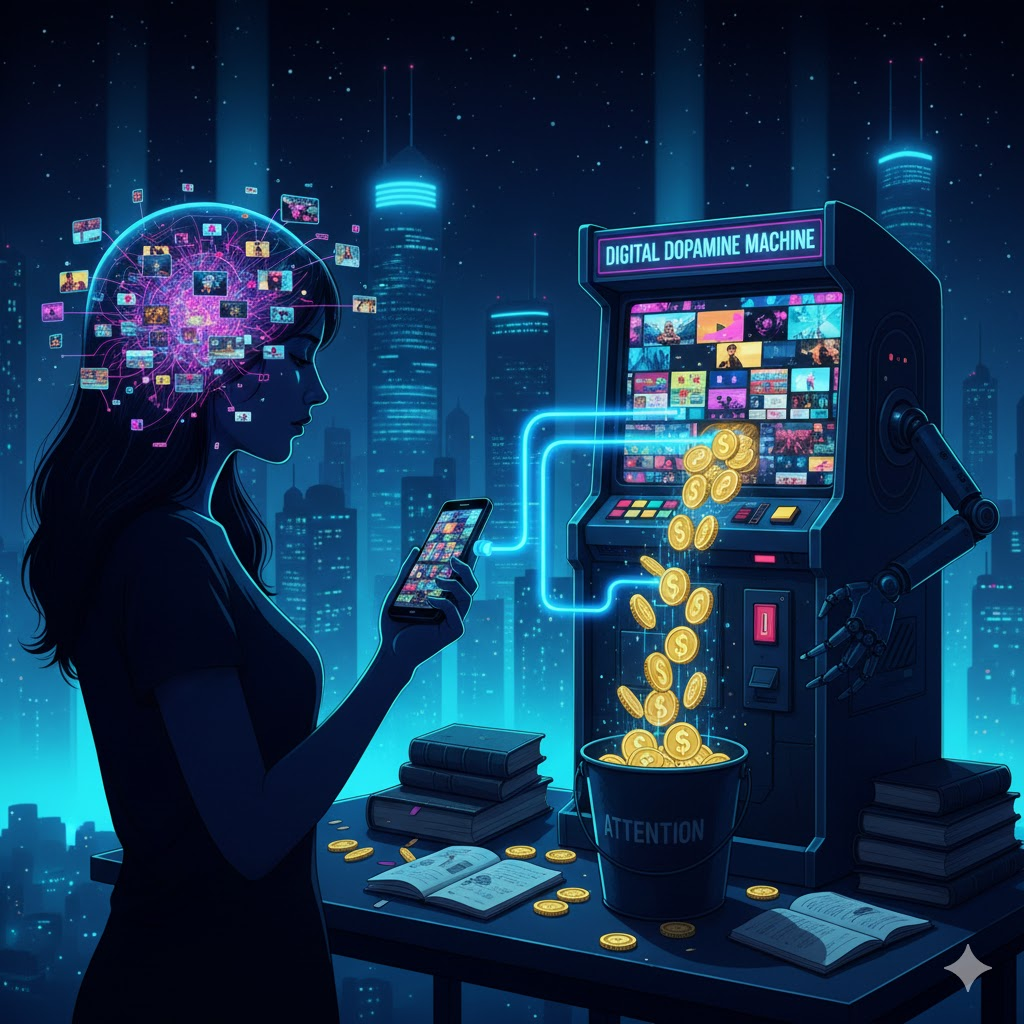
- 슬롯머신의 원리: 우리가 SNS 피드를 새로고침할 때나 숏폼을 위로 올릴 때, 무엇이 나올지 모르는 그 '기대감'이 도파민을 폭발시킵니다. 이 기대감에 우리는 계속 화면을 '추적'하게 되는데, 짧은 영상은 이 구조를 완벽하게 지향합니다. 이는 도박 중독의 메커니즘과 100% 일치합니다.
- 슬롯머신 디자이너 출신의 폭로: 구글의 전 설계 윤리 담당자였던 트리스탄 해리스(Tristan Harris)는 "스마트폰은 주머니 속의 슬롯머신"이라고 폭로했습니다. 기업들은 인간의 취약한 심리 구조를 '해킹(Brain Hacking)'중입니다.
자, 우리가 무심코 넘기는 15초의 영상은 그저 짧은 영상으로 그치지 않습니다. 수십 년간 지식과 자본과 욕망이 축적된 행동 설계 기술이 낳은 "디지털 슬롯머신'의 결과물"인 셈입니다.
다음 편으로 이어질 예정입니다.
이 글을 끝까지 읽어 주신 분들에게
진심으로 감사하다는 말씀을
전하고 싶습니다.
[문의]
- zuozhe0513@gmail.com
- Tistory 댓글
- geumjooeun_insta DM
"Please note that this text was translated by AI, so there may be subtle differences in nuance from the original."
It is said that once you start watching Shorts or Reels, two to three hours pass by in the blink of an eye. Have you ever had this experience? While there’s nothing quite like these short clips for killing time, you’re often left feeling strangely empty afterward. Yet, the temptation of these bite-sized videos remains irresistible.
What is the true nature of this temptation? And is the inability to break free from it really just a personal failing?
In 2024, the Oxford English Dictionary selected 'Brain rot' as one of its Words of the Year. It literally signifies the deterioration of mental faculties. This term continues to demand our attention because video content is becoming increasingly shorter.
Why Were Shorts and Reels Created?
Because We Are Human The human brain is naturally hardwired to respond to short, intense stimuli: movement, surprise, humor, anger, sexual cues, and rapid conclusions. These were essential survival instincts in the primitive era—the "brain of a time" when quick judgment meant life or death. At that stage, the brain did not evolve as an organ designed for deep contemplation. Short-form videos strategically exploit this specific evolutionary blueprint.
The Platform’s True Goal: "Time Spent" The revenue formula for platforms like Instagram and YouTube is singular: Dwell Time.
Advertising revenue is generated from Time Spent × Frequency. Deep understanding, reflection, and philosophy are not profitable ventures from a platform’s perspective.
On the other hand, short videos leave no room for thought or judgment. As you swipe and swipe, two to three hours disappear effortlessly. It is no exaggeration to call these platforms "Engagement Maximization Machines."
Why 'Brain Rot' is Not an Exaggeration
Excessive consumption of short-form content leads to actual changes in cognitive abilities. A decrease in attention span, avoidance of long-form text or videos, and a decline in the depth of thought—you encounter 'information,' but no 'understanding' remains. This is why people these days say: "I can't focus on books anymore." "I can't watch a video if it's too long."
This is not a matter of individual willpower. It is the result of neural circuits being rewired. Platforms do not want "thinking humans." They want the "reactive human"—someone who reflexively swipes the screen.
They Already Knew. They Already Researched.
Long before the advent of short-form video, corporations had spent decades researching fields such as behavioral psychology, neuroscience, reward circuits, and dopamine secretion patterns. It is common knowledge that Silicon Valley employs actual neuroscientists, and Big Tech firms have long hired experts to dominate the 'Attention Economy.'
Beyond just software developers, these companies employ PhD-level researchers in their UX (User Experience) teams to study which colors, notification sounds, and 'infinite scroll' methods trigger the most powerful dopamine hits in the human brain.
Hack the Psychology!
Looking at the data applied by leading short-form giants like Google and Meta (formerly Facebook) since the inception of their search algorithms and newsfeeds:
- Accumulation of A/B Testing: Everything from the placement of a button to the size of a red notification dot has been tested on millions of users to accumulate decades of data on the highest click-through rates. Short-form is the final evolutionary form of that research.
- Historical Background: Behavioral psychologist B.F. Skinner’s 'Skinner Box' experiment—which proved that rats become more obsessed when rewards are unpredictable—was completed in the 1950s. Big Tech has perfectly implemented this classical psychology into a digital net called the 'Algorithm.'
Behavioral Psychology and Reward Circuits
One of the core technologies corporations have refined over decades is 'Variable Reward.'
- The Slot Machine Principle: When we refresh an SNS feed or swipe up on a short video, the 'anticipation' of the unknown triggers a dopamine explosion. This anticipation forces us to keep 'tracking' the screen, a structure perfectly aligned with short-form content. This is 100% identical to the mechanism of gambling addiction.
- Whistleblowing by a Slot Machine Designer: Tristan Harris, a former Design Ethicist at Google, famously warned, "Smartphones are slot machines in our pockets." This means corporations are 'Brain Hacking' the vulnerable psychological structures of human beings.
The 15-second videos we mindlessly scroll through are more than just brief clips. They are the ultimate 'output of a digital slot machine,' engineered by decades of accumulated knowledge, capital, and desire through behavioral design technologies.
"To be continued in the next post."
I would like to express my sincere gratitude
to those who read this article to the very end.
[ Inquiries]
- zuozhe0513@gmail.com
- Tistory Comments
- geumjooeun_insta DM (Direct Message on Instagram)


댓글